Two social media marketing (SMM) services can have similar names and prices but begin delivering at different times. A label such as “fast” gives you little to plan around. You still need to know how long you are likely to wait before anything arrives.
NotPanel's Avg. start helps you make that choice. Where a measured estimate is available, it summarizes recent observed starts for the selected service. Compare it alongside the price and requirements to choose a service that fits your timing and budget before placing an order.
What does Avg. start mean?
Avg. start estimates the wait from order placement to the first delivery NotPanel observes. A measured 12-minute start means recent orders have typically taken about 12 minutes to show evidence of delivery. Completion time answers a separate question: how long the full quantity takes to arrive.
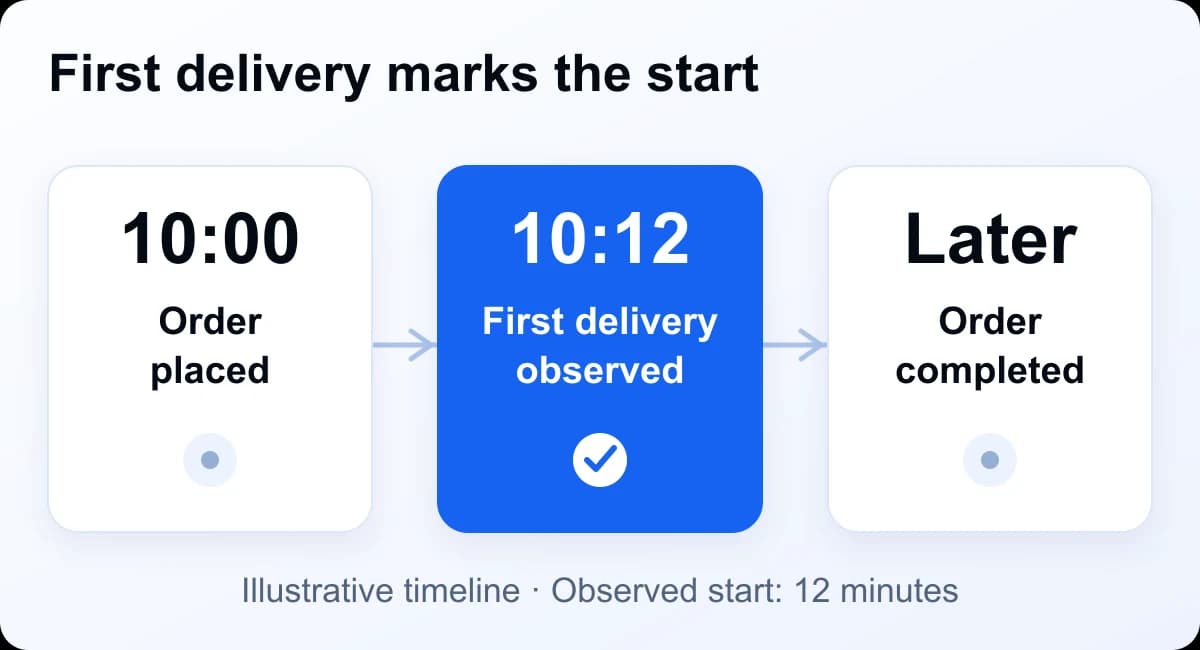
That definition makes the timing useful before checkout. If you need an early sign of progress, compare the wait for first delivery. If your deadline depends on receiving the entire quantity, read the service details and plan for the full delivery as well.
How NotPanel measures service start times
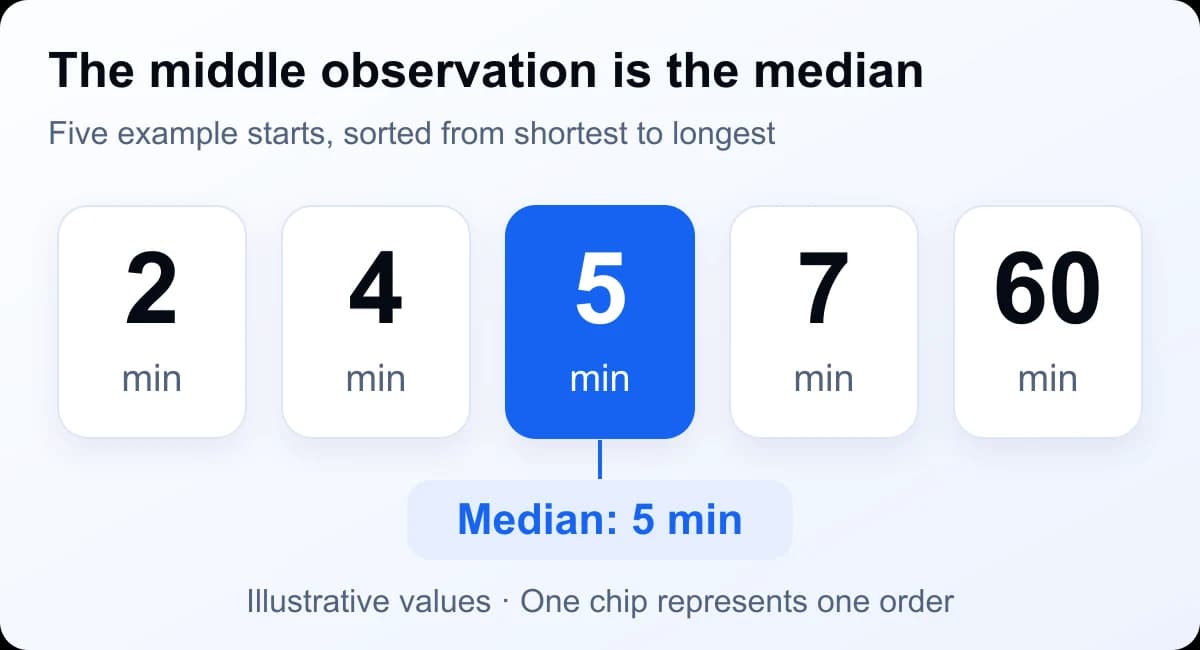
For a measured estimate, NotPanel takes the median of up to 50 recent observed starts for that service. The median is the middle time after the observations are arranged from shortest to longest. With an even number of observations, it is the midpoint of the two middle times.
For example, imagine five recorded starts of 2, 4, 5, 7 and 60 minutes. The middle value is 5 minutes. Their arithmetic mean would be 15.6 minutes. The median gives buyers a typical central value without allowing one unusually long wait to move it as far. The interface keeps the familiar label Avg. start; its measured value is this median.
What counts as delivery evidence?
Any confirmed positive delivery can count. If an order requests 1,000 units and a valid update reports 990 remaining, delivery has begun. There is no fixed one-percent threshold. A Processing label or an initial account count alone does not establish that units have arrived.
The observation is recorded when NotPanel receives the confirming update. It can therefore be later than the first units actually arriving. If completion is the first confirmation received, that update becomes the first observed delivery. This is why the definition uses observed start.
The measurement rules in plain language
- One order, one observation. Repeated updates and later drip-feed batches do not count the same order again.
- A recent rolling sample.The measured value uses up to 50 latest qualifying starts for the service's current delivery setup. A single observation can produce a value; 50 is a limit, not a minimum.
- Order history, not a fixed date range. The latest 50 observations can span different periods for busy and rarely ordered services. There is no fixed calendar-age cutoff.
- A readable duration.The result rounds up to a whole minute, with a minimum of one minute. It refreshes periodically as the service's timing is recalculated.
What makes this information useful?
A clearly defined measurement lets you compare the same question across suitable services. It also helps you separate a description of speed from evidence about previous starts.
| Timing signal | What it tells you |
|---|---|
| “Fast” in a description | How the service is advertised. |
| Processing status | Which status has been assigned to your order. |
| Completion time | How long the whole order takes. |
| Measured Avg. start | How long recent orders waited before delivery was first observed. |
NotPanel brings that last question into service selection. You can weigh the wait against the price instead of discovering the difference after buying. For a reseller, it also gives a concrete basis for explaining when a customer should look for the first sign of progress.
How to compare two services using Avg. start
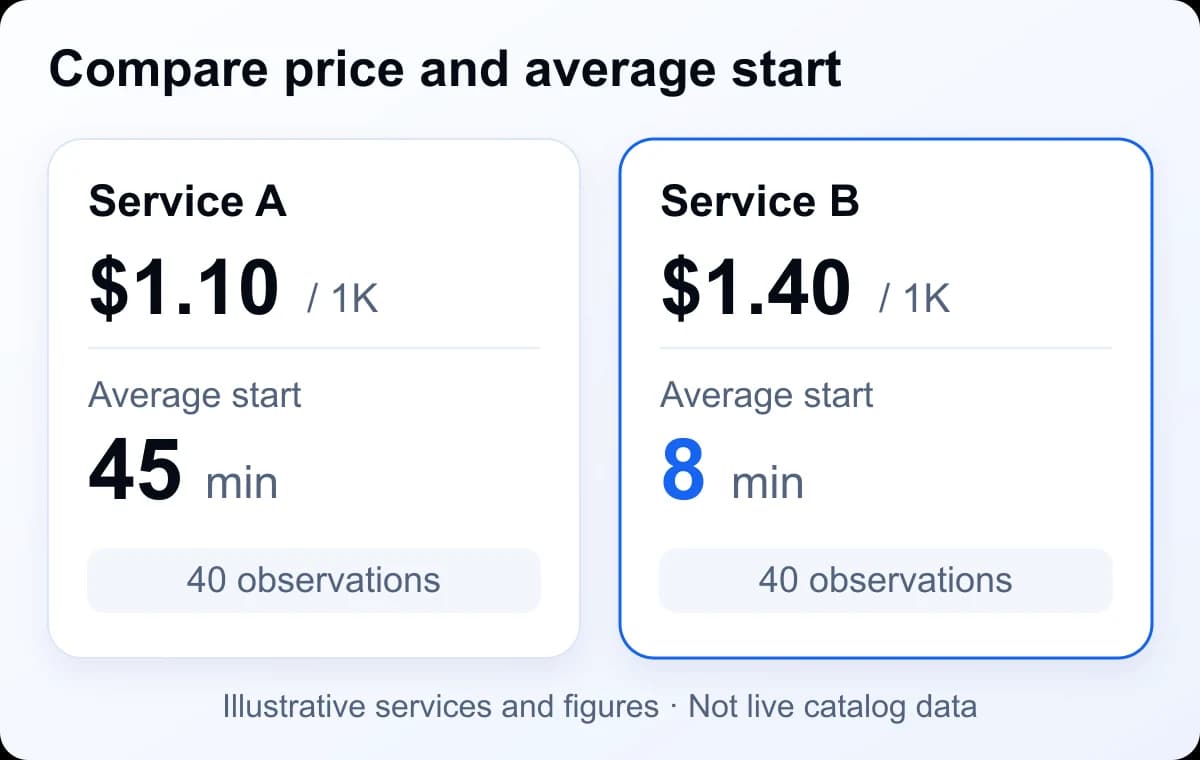
Suppose both services below meet the same platform, quantity and service requirements. These are illustrative prices and observations, not current NotPanel offers or performance results.
| Detail | Service A | Service B |
|---|---|---|
| Price per 1,000 units | $1.10 | $1.40 |
| Measured typical start | 45 minutes | 8 minutes |
| Observed starts | 40 | 40 |
If earlier first delivery matters, Service B may be worth the extra $0.30 per 1,000 units. If the schedule is flexible and budget matters more, Service A may fit just as well. The useful choice depends on what you need from this order.
A shorter start alone cannot establish which service finishes sooner or has better overall delivery quality. Pair timing with the current requirements, availability and feedback from delivered orders. Starting quickly is one part of the decision.
Compare current service start times in the public catalog. You can browse without an account; placing an order requires sign-in.
How much confidence should you place in the estimate?
Start with the selected service's evidence. A value backed by one order tells you less about repeat behaviour than a value backed by many observations. Even the latest available observations can be older for a rarely ordered service. A short time is useful when you understand what supports it.
Measured, estimated and unknown
A measured value has observed orders behind it. The public catalog shows the duration; it does not currently show a sample count beside every service. The catalog API documentation explains the timing basis and sample count for integrations:
- Measured: a numeric timing value with at least one recorded observation.
- Estimated: a stored numeric timing value without a measured sample. Read it as unmeasured guidance.
- Unknown: no numeric timing value is available.
Automatic measured estimates come from observed orders. A generic supplier delivery-time description is not automatically substituted for missing start evidence. If no usable value is shown, treat the start time as unknown and assess the service's other details.
Current coverage and the historical order review
Measured timing is available for part of the catalog. The live Price Index shows the coverage and number of observations for its dated snapshot. Its platform-level timing summarizes measured service values; it is not the estimate for every service on that platform.
NotPanel's team also reviewed 10,000 orders on 6 September 2026 and reported that starts generally tracked the estimates customers had seen. That historical review covers a group of orders. The current sample behind an individual service is its own rolling set of up to 50 observed starts. Use the live service information when deciding what to order today.
Where to find Avg. start on NotPanel
- Open the public catalog. The catalog sorted by average start puts the shortest available values first. Choose a platform and compare services with matching requirements.
- Read the timing with the price. Look for the clock and duration on a service. Missing timing means unknown; it does not mean an instant start.
- Confirm before submitting. After signing in, New Ordershows Avg. start in the selected order's summary. Check the target, quantity and total charge at the same time.

You can use the Price Index's Start-time evidence filter for an overview of measured coverage by platform. That is a broader comparison; return to the exact service before choosing your order.
Drip-feed and subscriptions: separate timing from scheduling
A drip-feed order can contribute its first observed start while later batches are still waiting. Batch intervals describe how the order is spaced out. NotPanel limits new drip schedules to runs × interval within 48 hours, subject to tighter service limits. That scheduling budget is separate from a delivery-completion estimate. The drip-feed guide explains the quantity and schedule fields.
For scheduled subscriptions that create separate run orders, each run's clock starts when its order is placed. Future-post triggers and subscription delays determine when work becomes due. Read those settings separately from an observed start; an Active label or next-run date does not establish that delivery has begun.
Frequently asked questions
Does Processing mean my order has started delivering?
Processing is an order status. NotPanel records an observed start when an update confirms positive delivery, or confirms completion if no earlier delivery was observed. A Processing label or a starting account count alone does not establish delivery.
Is Avg. start a mean or a median?
For a measured service estimate, NotPanel uses the median of up to 50 recent observed starts. The median is the middle time after the observations are sorted; with an even number, it is the midpoint of the two middle times. The displayed result is rounded up to a whole minute, with a minimum of one minute.
Does a shorter start time mean a better service?
A shorter measured start can help when earlier first delivery matters. Start timing does not measure completion speed, retention or overall delivery quality. Compare suitable services using their requirements, price, available order feedback and timing together.
Why is the start time missing for a service?
A missing start time means there is no usable timing value to display. Treat it as unknown. It does not mean zero waiting time, and it does not establish that the service is slow.
What should I do if my order starts later than the estimate?
Open Orders in your dashboard and check the current status and available progress. If you need help, open an order support ticket and include the order ID. An average start time is a comparison estimate, not a cancellation or refund deadline; the order's available actions and the refund policy determine those options.
Does a drip-feed order have to finish before its start counts?
No. Its first confirmed positive delivery can contribute a start observation while later batches are still outstanding. Each order contributes once, so later batches do not repeatedly add samples for the same order.
How does start timing apply to subscriptions?
For a scheduled subscription that creates separate run orders, each order's clock begins when that run order is placed. Waiting for a future post or scheduled run is separate from its delivery start. A subscription's Active status or next-run date does not by itself provide a measured start for its deliveries.
For a delayed order, check Orders and contact support with its ID when you need help. The order-protection guide explains cancellation and refund rules separately from timing estimates.