
You cannot establish an SMM service's fulfillment route from its price or the word “source” on a homepage. The useful buying question is more concrete: what is being promised, what evidence supports it, and who handles your order when something needs attention?
This is NotPanel's guide to checking claims, not an independent ranking of suppliers. For a general first-purchase checklist, use our guide to choosing an SMM panel. Here, the focus is the evidence you need before treating a sales description as a fact.
First, ask what “source” means for this service
A seller may use “source” to mean it directly operates a particular service. A reseller offers a service fulfilled by another party. A broad label still leaves questions: does it describe one service, a group of services or the entire catalog? Is it a statement about delivery, pricing, ownership or simply branding?
Imagine two sites listing a similarly named service at $1.80 and $2.10 per 1,000. Those hypothetical prices tell you what each site asks for that row. They do not show whether the sites share a supplier, have different commercial arrangements or provide equivalent service conditions. Even an identical name is a starting point for comparison, not proof of a common route.
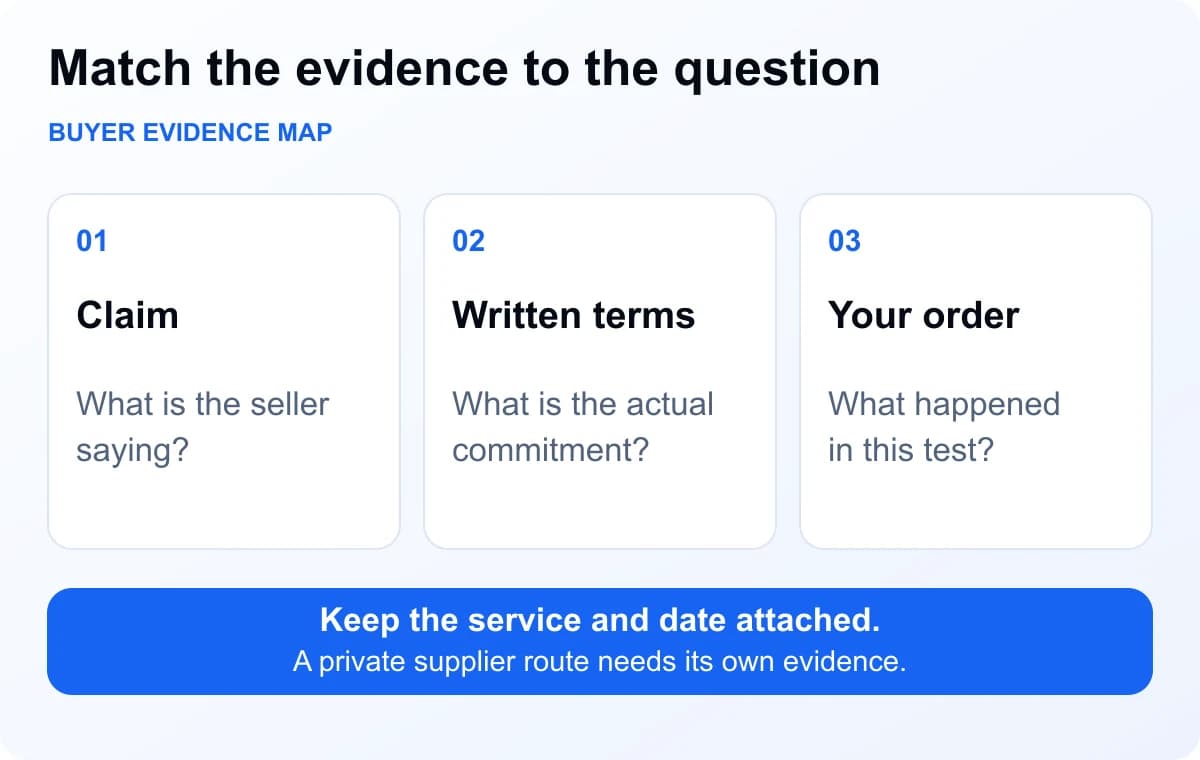
Checks 1–3: make the claim specific
- Which exact service does the claim cover? Save the service ID, name and date. A statement about one row should not silently become a statement about the whole catalog.
- What is the claimed benefit? Ask whether “direct” means a particular capability, a price arrangement or an operational role. Compare the buyer-facing benefit that is actually described.
- Who accepts responsibility for the purchase? Identify the account you pay, the terms you accept and the support channel that handles your order. A supplier label should not leave you guessing where to request help.
At NotPanel, you can inspect the public service catalog, read the Terms of Service and find the published contact routes before depositing. Those pages help you understand your purchase and the operator's commitments.
Checks 4–6: connect the promise to written terms
- Does the service description match your intended order? Check target format, quantity limits and required inputs. “Same platform” is too broad a basis for treating two offers as interchangeable.
- What does the timing claim measure? Separate first delivery, completion and a scheduled run. In NotPanel, read Avg. start together with its available evidence and sample information. The average start-time guide explains how to use that signal.
- What remedy applies to this order type? Find the cancellation, refund and refill conditions before ordering. A general “refund available” statement is not enough. Use NotPanel's Refund Policy and order-protection guide for the applicable conditions.
Checks 7–9: ask what the evidence actually shows
- Are performance examples dated and service-specific? An order screenshot without a date, service or explanation of what was measured is hard to apply to your choice. Protect personal information when sharing your own records.
- Can you see the size and meaning of feedback? Counts are more informative than an isolated percentage. Check what makes a buyer eligible to vote and whether the feedback concerns this service. NotPanel's likes and dislikes guide explains its order-linked feedback.
- Are you confusing a different signal with delivery evidence? Domain age, a polished interface and a secure connection answer different questions. Chrome's secure-connection guidance describes connection privacy; it does not certify a seller's fulfillment claims.
Checks 10–12: keep a useful test record
- Can you trace one intended purchase? For a small order, record the service, target, quantity, accepted charge and order ID. Keep the test narrow enough that you can understand its outcome.
- Can you reconcile the result? Record the order status and any adjustment, then check Wallet history. An order marked complete and a payment record answer different questions. A refund amount due and a credited Wallet transaction are also different states.
- Can support address a real uncertainty? If something in the test needs explanation, send one clear ticket with the order reference and question. Keep follow-ups in that conversation while the ticket remains active. Our support guide explains routine assistance and cases that need a human review.
Use three decisions, not a guessed supplier score
Mark each important question answered, needs evidence or pause the purchase. An unexplained target requirement or unclear remedy is a reason to resolve that issue before increasing spend. It is not evidence that you have discovered the seller's private supplier chain.
Frequently asked questions
Can a public website prove that an SMM panel is the original source?
A low price, similar service names, domain age or a large catalog does not establish the fulfillment route of an individual service. Ask what the operator is claiming, what evidence supports it and who is responsible for your order. Keep any conclusion as narrow as the evidence.
Is a directly operated service automatically better than a resold service?
The label alone does not establish suitability, delivery, support or refund treatment. Compare the exact service definition, current terms and your own test result before choosing.
What does a successful small test prove?
It gives you evidence about that order, at that time, under those conditions. It helps you evaluate the buying and support process, but it does not reveal every supplier relationship or establish how all future orders will perform.